Thursday, August 5, 2010

Macapuno Pie with Langka


Just recently, cousin Cielo brought home three pieces of Macapuno given to her by a friend. They were sitting at the kitchen counter for a few days until I decided to break them open and do whatever I can with them.

I wanted to do a Minatamis but the Macapuno are too many for that so I instead opted to make Macapuno balls and made some into Macapuno pie.


Macapuno Balls

Ingredients:
1 nut Macapuno
1 can Condensed Milk
1/2 cup granulated sugar for rolling

Procedure:
Grate the Macapuno into shreds using the very Pinoy "pangkayod ng melon"
In a saucepan, mix the grated Macapuno meat and 1 can condensed milk.
Stir over low fire until you get the consisterncy of a yema, about close to 1 hour.
Allow to cool and form into balls.
Roll in granulated sugar.
Serve!

We feasted on the balls for a few days until we got tired of eating them. The next day I decided to make a macapuno pie out of the Macapuno yema leftover.

Macapumo Pie

Crust Ingredients:
1 cup flour, chilled
1 stick butter or margarine, chilled and cubed
1 tsp salt
1 tsp sugar
1/4 cup cold water

Procedure:
Since I don't have a mixer, I just put all ingredients together in a mixing bowl and crumble it all in my hands until i get a crumbly flour much like japanese breadcrumbs.

Then teaspoon by teaspoon I added cold water until the flour-butter mixture formed into a dough. I kneaded it a little and form it into a ball. I wrapped it in plastic and put in the ref for about 30 minutes.


After 30 minutes, I divided the dough into 2 for the bottom and top crust, rolled each ball of dough into thin sheets and place 1 sheet in a pan.

I filled the dough-lined pan with the Macapuno yema, halfway only coz I didn't have enough Macapuno left.

I covered the top with the other sheet of dough and sealed the edges by overlapping the bottom and top dough. I made some decorative edges using just my fingers. Then I brushed eggwash for a shiny finish when baked.I popped it in a 350F preheated oven and baked for 20 minutes. Voila! Macapuno Pie.
I topped it with Minatamis na Langka. I got the Langka from Nagcarlan, Laguna.


Wednesday, August 4, 2010

Pesa, Swam, Nilaga & Tinola: How Much Difference Do They Make?


Kuya Wek brought home two Red Snappers. One I made into Sweet and Sour and the other I made into Pesa.

Pesa is one of the tastiest soupy dishes I really miss so when cousin Wek brought home some red snapper from Lucena, I immediately made it into a pesa.

I don't know where the word
pesa came from but it is similar to nilaga or tinola, if they are not actually the same. Another dish that is reminiscent of pesa is swam.

Now I'll try to differentiate each dish although I can't seem to find any difference to them.

Mother makes
Pesang Lapu-lapu or Bangus. She uses ginger, whole black peppercorns, pechay, cabbage and potatoes, just like making Nilagang Baboy but this time, fish is the main protein.

Then she makes
Swam na Usohos, that elongated silvery fish that is so tasty and has a biya-like flesh texture that can either be fried or made into swam, this time without pechay or repolyo or patatas but Dahon ng Sili instead. But the procedure is the same--laga or boiled.


Usohos or Asohos. Tasty small fish best cooked into Swam. It can also be fried.
She calls boiled meat-- pork or beef-- with the same vegetables as found in pesa as Nilaga i.e. Nilagang Baboy or Nilagang Baka. Then with the same procedure of boiling but this time she uses Chicken, she calls it Tinola with either chayote or green papaya as the main vegetable. We never call it Nilagang Manok!

Usual Suspects. You normally find these in any Nilaga dish.

So what really is the difference if they are all nilaga? Why can't they just call it nilaga collectively? Nilagang Baboy, Manok, Lapu-lapu, Bangus, Usohos.... etcetera!


Anyways, another famous pesa aside from the grouper or snapper is
Pesang Dalag which, according to my mother is prepared slightly different and a little more complex by the addition of tahure. Tahure is tofu aged with salt and water. Aging makes the tofu richer and the texture becomes more like feta or any soft cheese. And it is salty, nutty and a tastes a bit like rotten. I have made Pesang Dalag once or twice and certainly mine is not the definitive version.

In some regions, Pesa(of any kind) is accompanied with Miso dip. Miso is a by-product of tofu. But tahure is more pungent and has a s tronger flavor. It is an acquired taste.

I use tahure more in
Tocho and in dishes that you put black beans or tausi in. Tochong Bangus is my second most favorite bangus dish of all time. The # 1 is plain pritong bangus that is extremely salty.

Here's how you prepare it:
Fry to golden crisp overly salted bangus. Set aside.
In a saucepan, sautee onion, garlic, tomatoes, grated ginger and tausi.
Add 2 pcs. crumbled tahure soaked in 1/2 cup vinegar and continue sauteeeing.
Add the vinegar where you soaked the tahure, 3 tbsp soy sauce and 1 cup water. Bring to a boil.
Finally, add the fried bangus. Adjust salt, pepper and vinegar if necessary but the saltiness of the bangus should be enough to season the dish.

Where was I, I forgot the point that I was making.....Ah there! So, cousin Wek brought home a red snapper which I made into Pesa....

Here's the recipe:

1 medium size (about 1 lb) red snapper or bangus
1 medium size ginger, sliced and crushed
1 tsp black peppercorns (crack some of it)
1 big red onion
1 big potato, cubed
1 bunch pechay
1/2 head repolyo
1 liter water
salt or patis to taste

Procedure:
Clean the fish and set aside.
In a pan put water, onion, ginger, pepper and potatoes together and bring to a boil. Add the fish, pechay and cabbage and allow to simmer until the fish is cooked through. About 8-10 minutes. Season with patis or salt.


Easy to cook. And just as easy to be gone-- before I can even photograph the finished product! All there is left are smiles on the face of those who finished it!!!

Friday, July 30, 2010

Jeff Corwin

One of my most favorite food shows is Extreme Cuisine with Jeff Corwin. That goes without saying that one of my favorite food personality is of course Jeff Corwin. Jeff was known as an animal conservationist through the programs The Jeff Corwin Experience and Corwin's Quest on Animal Planet where he is also an executive producer; and Going Wild with Jeff Corwin on the Disney Channel. When he's not busy saving wildlife, he moonlights as food traveler for the Food Network.

Jeff takes us to the farthest reaches of the world looking for the weirdest cuisine and the oddest ways of preparing them. He presents it with humor that makes you love him more than the food he presents. He's travelled to the countryside of England where he fished in the mud searching for eels; to Scotland where he was made to eat Star Gazzy Pie-- a pie made from the heads of the sardines, gills and all; to Mexico for the oddest corn bread recipe and to others like Morocco, Bangkok and New Zealand.

I wish I can tell more about this "papable" Jeff Corwin but all I know about him is what I see on TV. So check out this funny foodie and traveler at The Lifestyle Network (check local listing). Or visit the Food Network website for the in depth information about him. (I don't want to plagiarize!)

Here's one of his favorite recipes:

Thai Green Papaya Salad (Som Tum) with Grilled Thai shrimp

Jeff Corwin

Recipe courtesy Jeff Corwin


Ingredients

  • 1 large or 2 medium green papaya (see Cook's Note)
  • 1/2 pound green string beans
  • 4 tablespoons freshly squeezed lime juice
  • 4 tablespoons Thai fish sauce, nam pla
  • 4 tablespoons palm sugar, available in most Mexican, Latin or Asian supermarkets, or substitute brown sugar, or white sugar
  • 2 large carrots (peeled and shredded to the same strip-size as papaya)
  • 1/4 cup loosely chopped cilantro leaves
  • 1/4 cup loosely chopped mint
  • 4 tablespoons dried Thai shrimp, optional
  • 2 to 4 Thai chiles also called prik chiles, minced
  • 1/4 cup unsalted peanuts, toasted and lightly crushed
  • Jeff's Thai Grilled Shrimp, recipe follows
  • Jasmine sticky rice, or steamed vermicelli rice noodles, optional, as an accompaniment

Directions

Peel the papaya (I use a standard vegetable peeler), then slice papaya in half and scoop out black, slippery round seeds and some of the stringy flesh, but be careful not to scoop into good, firm flesh for the salad. Shred the papaya on a mandoline or a box grater. Set aside.

Snip off the tips of the green beans. Bring a large pot of water to a boil over medium heat and add the beans. Cook until crisp tender, about 3 to 4 minutes. Drain and quickly add the beans to ice water. Cut the beans in half, about 2-inches in length and add them to a large bowl.

In a large mixing bowl whisk the lime juice, fish sauce, and sugar, until the sugar is dissolved. Mix in the shredded papaya, green beans and carrots until well coated (I like to use tongs for this). Toss in the cilantro, mint, and dried shrimp. Then mix in the hot chiles, to taste. Let salad stand for 20 minutes or up to 2 hours, covered in the refrigerator.

Before serving, mix in most of the crushed peanuts, reserving a few tablespoons for garnish. When serving, mound the salad in center of a plate and sprinkle the remaining peanuts on top. The dish can be served on its own, or with Thai Grilled Shrimp and Thai jasmine or sticky rice, or with steamed vermicelli-rice noodles.

Cook's Notes:

- Green papaya is an unripe papaya, the flesh is very firm, and greenish-white in color (not orange-red, soft and sweet like a ripened papaya). Green papayas are available in most Asian (especially Thai, Cambodian and Vietnamese) grocery stores. Check your local Asian shopping center. If you can't find unripe green papaya, you can substitute unripe mango (very hard, woody and sour to the taste or very firm, unripe zucchini, or you could mix the two. If you go with these, follow same directions as with papaya).

- Thai fish sauce (nam pla) is available in most grocery stores. When you first open the container and smell, it may come across as a bit fishy, but trust me, it is often the most important ingredient in S.E. Asian cuisine.

- Peanuts: I prefer to toast my own, it's far easier than it sounds. Heat a large fry pan over high heat for 1 minute, then add whole raw, skinless peanuts. Turn down the heat to medium-low and keep constantly stirring and flipping the peanuts in pan, make sure you don't scorch them, but it is fine for them to get browned little heat (toasted) spots. If you smell acrid-smoke odor, then you are burning them, the aroma should smell almost like fresh peanut butter. Should take around 7 to 10 minutes to cook them. After 7 minutes take a few nuts and let them cool, taste them, if they are crunchy then done, if still a little soft and raw tasting after cooling then toast some more. You can toast a pound in advance and store them in a zip lock bag or glass jar for a couple of months or so. Once you start toasting your own peanuts you'll never buy jarred ones again, but if you don't want to toast your own then you can use unsalted, dry roasted peanuts. For the papaya salad, loosely crush the nuts. I usually do this by placing nuts in a resealable plastic bag or in between a few layers of paper towel. Then roll with a rolling pin or smash with a mallet. Again, loosely crushed, NOT crushed to point of being crumbed or to near peanut butter state.

- Dried shrimp: Some western pallets find this a little too exotic and fishy to the taste, but for me Sum Tum isn't Som Tum without dried shrimp. It you are a wee bit leery about using the dried shrimp then just add a tablespoon or 2, or serve in side dish and let diners add them to their own plates.

- Thai chiles: These are the small, 1-inch long red and green peppers that are VERY hot. If not available you can use jalapeno or habanero peppers. I mince chiles with the seeds. Traditionally Sum Tom or papaya salad is a very spicy dish in Thailand.

Jeff's Thai Grilled Shrimp

For marinade:

  • 1/2 cup Thai sweet chili and garlic sauce (recommended: Mae Ploy now available in most grocery stores)
  • 1/4 cup hoisin sauce
  • 2 cloves garlic, finely minced
  • 1/4 cup ponzu sauce, or substitute the juice of 1 lime
  • 1 1/2 teaspoons soy sauce
  • Splash Thai fish sauce, nam pla
  • 1 teaspoon sriracha sauce
  • 1 teaspoon curry powder
  • 1 teaspoon ground ginger
  • 4 or 5 sprigs mint, leaves removed and finely chopped, or substitute Thai basil
  • Handful cilantro leaves, finely chopped
  • 3 pounds large shrimp

Preheat grill to medium heat.

In a large bowl whisk all the marinade ingredients together. Add the shrimp and let marinate for up to 1 hour. Grill the shrimp 4 to 6 minutes each side until they begin to curl, get pink in color and firm up. Do not over cook or they will get rubbery. Brush the shrimp with the marinade during grilling. Put the remaining marinade in a small saucepan and bring to boil over high heat. Cook the marinade for at least 2 minutes and serve it as a sauce on the side. Serve the shrimp with the papaya salad.

Cook's Note:

This marinade/sauce is great with chicken thighs and pork tenderloin. If using chicken or pork then double the marinade recipe, marinate for 4 hours, and grill accordingly.

Whew!

Wednesday, July 28, 2010

Counting The Beans


Since I started food blogging just this year, the one person who really never missed a single post is the Beancounter who is a long time food blogger himself. He makes efforts to like my links on facebook and comments on blogspot. That is impossible to reciprocate because he has written hundreds and hundreds of posts mostly about their dinner, their eating out and their travels. And he writes like the food writers you read on food magazines! He also is a great photographer. I admire his stunning shots even on mundane subjects as dahon ng sili. I swear I’ll set a Beancounter Day when I’ll pay for an eight-hour internet block time in my favorite cybercafé just to read his blog in its entirety! No Facebook, no Youtube (and Youporn!), no CNET, no NYT online no nothing!


A screenshot of his blog. Check this out at www.kidpawan.blogspot.com

I’m posting this first article of a series of posts (about foodies, chefs and food celebrities I like) as a gesture of my appreciation for the Beancounter’s patronage of my blog despite how novice, amateurish and so-so I write. Most of the time, I’m writing with only him in mind, incorporating the humor that I know would make him laugh knowing that he’s gonna read my post. In fact, he’s the only one that I’m certain would read my posts! Believe me, fewer than the number of fingers in both my hands and feet read my blog regularly. Some are random readers thanks to the “next blog” clickable at the top of the page. Still, I just carry on with my dream of becoming the next chez pim. And Beancounter.

I won’t spill the beans on his identity because I’ve not asked permission from him, the Beancounter is based outside the country for many, many years now yet he’s a die hard fanatic of Pinoy food and culture. In his blog you’ll see scores, if not hundreds, of articles about Filipino cuisine and his love affair with it.


Check out this great and legendary (not the kind na buhay pa, muka nang alamat ha!) blogger by clicking the link below or type the typographically erroneous www.kidpawan.blogspot.com on your browser.


Monday, July 26, 2010

The Banana Heart


Everybody is familiar with the banana heart. I don’t know if the heart is THE banana flower itself or is just the casing of the banana flower (what about the banana blossom inside the heart?) but I’m certain it is where the banana fruit develops from. So technically it is the banana flower however unflowery it may look. It looks like a fruit to the uninitiated (read: idiot) because it really looks like one. Just like a caterpillar or a tadpole that metamorphose into a completely different being when they mature to the next level of their life cycles.


Different types of banana bear their own respective variety of heart. They differ slightly in shape and size, although all of them are generally in the form that more or less resembles a heart; some are more elongated, some are more like a sword. The colors of their outer “petals” differ, too, ranging from red to yellow to green, but they are mostly red. The heart of the saba banana is for me, the definitive of all. This variety of banana heart is the one you will most likely find sold in the market especially in Metro Manila. But if you stroll in the public markets of Southern Tagalog, chances are, you’ll find other kinds in all shapes, sizes and colors.


Flower or not, this red or reddish yellow heart-shaped plant part of the banana tree (now, I’m confused whether to call it a vegetable or fruit) is highly edible and is treated mostly as a vegetable having made its way into some popular dishes like Kare-Kare, as a vegetable addition to Sinigang na Bangus; or even stand on its own as Ginataang Puso or just plain boiled dipped in bagoong sauce. I know some people from the Visayas that make pickled banana hearts using only the innermost core of several banana hearts, jar them and pour cooked mixture of sugar, vinegar and spices much like making atsara.


Preparation of this vegetable is easy. Just take away the outer petals along with the “infant” bananas that cling which tend to be hard and fibrous. It’s just like discarding the outer layers of cabbage. Then after 3 or 4 layers, you get a light yellowish-reddish layer that is so tightly wrapped around the core that is difficult to peel already. That’s when you know when to stop peeling. Then cut it open by slicing it in the center and it will reveal all the unborn bananas hidden in its core. Heads up because it excretes a mild but nevertheless staining latex that can stain your clothes and it’s almost impossible to get rid of even if you bleach it.

I made a dish, meatless kare-kare with the banana heart as the main “meat”. Stroll down the blog to see the recipe.

Monday, July 19, 2010

The Pandan Fruit

Just this weekend, my cousin brought home a strange fruit that resembles a pineapple at first glance but develops similarity to an exotic palm fruit as you look closer. Its color is vivid orange fading into yellow in other parts of this spiky round fruit. It is hard to the touch and has spikes of what looks like clustered together pieces of “unborn” bananas that you find when you cut open a banana heart. The skin is similar to that of the pineapple. The name, Pandan Fruit.


Yes, you read it right. Pandan bears fruit. Not the kind of pandan that we all know, though. Yes, you read it right again. There are different kinds of pandan. Usually, the pandan we know is the kind that we put in our sinaing, or the one we boil to extract a flavoring we use for buko-pandan or pichi-pichi and other kakanins. This variety of pandan grows no taller than 11/2 feet maximum and are known for their fragrant leaves.

In far away places like Real, Quezon, people grow giant pandan plants not for food but for the fibrous leaves that can be dried and woven into mats, baskets and other native stuff. It’s a tradition there and a cottage industry, too! You won’t see them in the hi-way unlike the plant that walis tambo is made from.

These varieties of pandan grow larger than human beings around 8 to 10 feet tall, with wide leaves of up to 6 inches in width when mature and they grow flowers and fruits. It is indeed Pandanzilla! They are grown in moist areas without further maintenance on the part of the grower except during harvest time.

Cousin Wek is contemplating on bringing a plant or two to transplant into his front garden. Knowing him and his penchant for everything exotic, bizarre and out-of-this-world, I wouldn’t be surprised if one day I’ll see this monstrous plant will be a centerpiece in his wild garden. It will be beautiful!


Wednesday, July 14, 2010

The Fruit of Passion


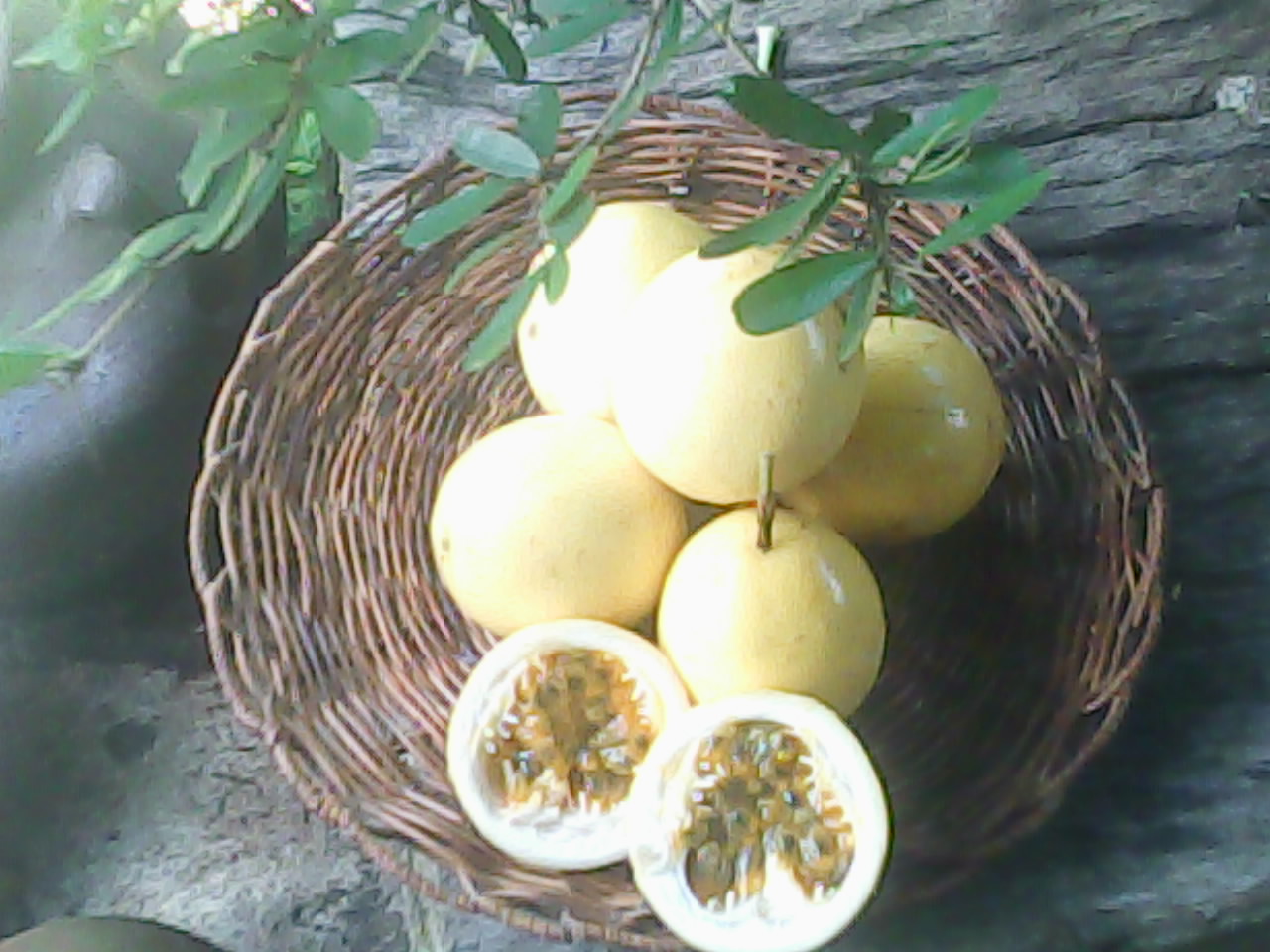
Aren't they lovely?
I was watching "4 Ingredients" yesterday and they featured a dessert made of Passion Fruit Yoghurt and fresh berries frozen to make sorbet. Then this morning, I was amazed to find some Passion fruits in the market. I immediately grabbed some.

The seeds are like that of the Dragon Fruit's
Passion fruit is not a regular fare in the market unlike other fruits like guyabano or pomelo, You are lucky if you spot a few vendors selling them on regular days. They are generally not treated as a delicacy by the public despite their rareness; instead they are seen as wild forest fruit in the likes of manzanitas, yambo and starfruit which have a following on a certain limited demographic (usually older people).

Elementary kids like it for its asim.
Chances are, you are more likely to find passion fruit in elementary schools hawked alongside green mangoes, santol and "sundot-kulangot" (a small bamboo vessel containing molasses that you pick with a bamboo stick). The kids like its asim taste. The more sour it is, the better it sells.

Doesn't that look delicious?
I, too, have seldom encountered passion fruit. Like, in my entire life, I have only eaten the actual fruit about 20 times yet. That's less than twice a year. But I do consume food products that contain passion fruit as in yogurt, juices and confectionery.

I would describe it as a yellow round citrus with quite a hard skin (not that would give when you press it). Inside you'll see black seeds surrounded by juicy yellowish pulp that are not segmented unlike most citruses. You take out the pulp with a spoon or even with just your tongue or teeth and the juices will burst in your mouth wonderfully. You can choose tos pit out the soft seed or swallow them. It tastes citrusy like a lemon or calamansi, only sweeter.

I made a juice drink out of it.

Another way to enjoy it is by making a juice drink out of it. I made one this morning.

Passion Fruit Lemonade

The pulp of 5pcs Passion Fruits
1/2 cup simple syrup
1/2 liter drinking water
ice to fill the pitcher

Mix everything together in a pitcher and serve.